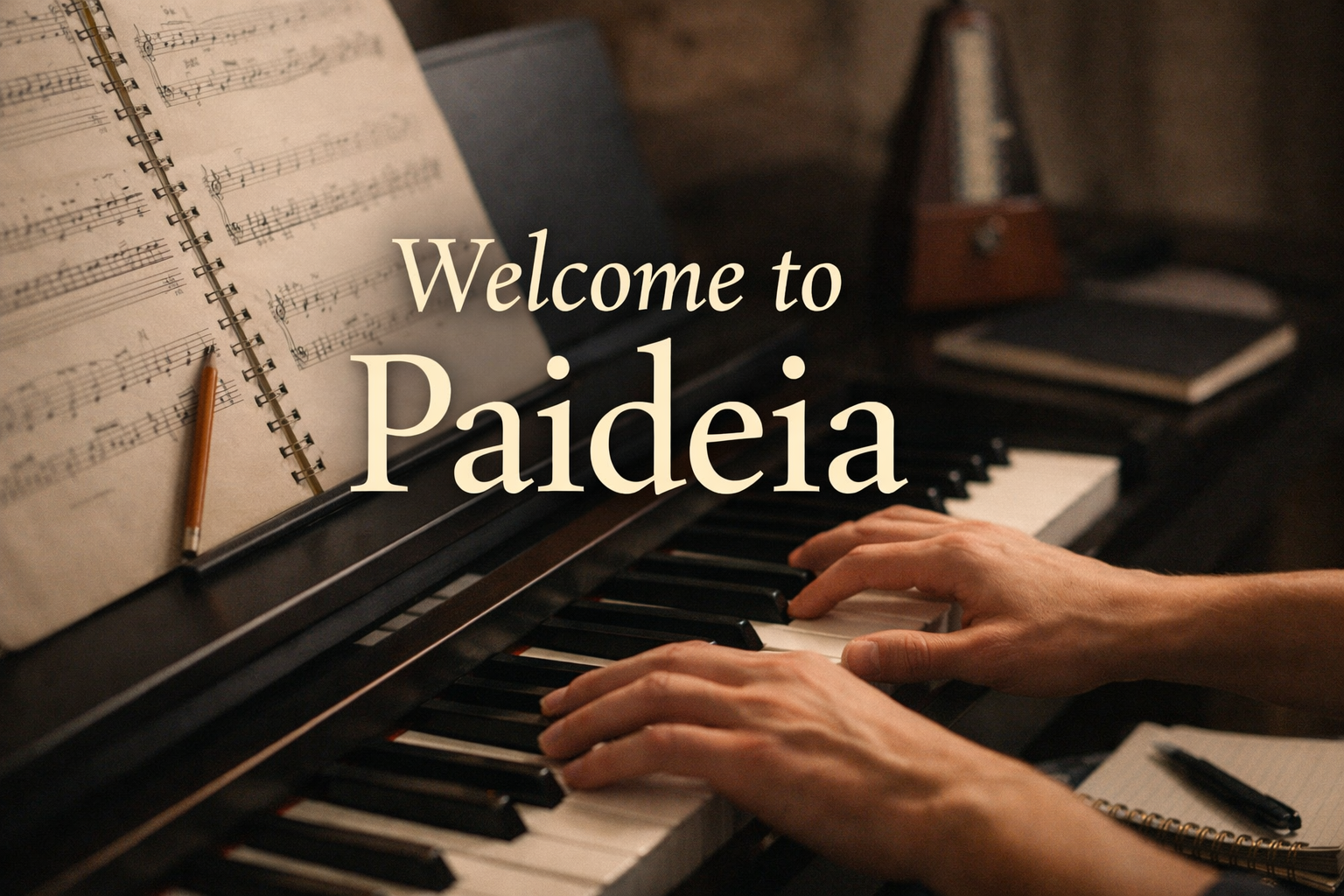
Welcome to Paideia
Why I built Paideia, what the name means, and why making piano practice visible matters.
Welcome to Paideia
There’s a quiet problem with how most people practice piano.
We sit down, play for a while, repeat a few passages, and hope that time at the keyboard is turning into progress. Some days feel productive. Others feel scattered. After a few weeks, it can be surprisingly hard to answer a simple question: am I actually improving, or just spending time?
That question is a big part of why I started building Paideia.
What does “Paideia” mean?
Paideia (παιδεία) is an ancient Greek idea centered on formation: the shaping of the self through disciplined practice, education, and habit. It is not just about collecting information. It is about becoming.
That idea felt right for piano.
Learning an instrument is not one dramatic leap. It is slow, deliberate formation. A scale practiced carefully. A difficult measure repeated patiently. A rhythm finally understood. A phrase played a little more musically than yesterday.
Real progress often happens quietly, and because it happens quietly, it is easy to miss.
Why I’m building this
I wanted a way to make practice more visible.
Not just total time, but the shape of practice over days and weeks. Consistency. Momentum. What got attention and what got neglected. Whether I was actually returning to the work that mattered, or just doing whatever felt easiest in the moment.
There are plenty of generic productivity tools in the world, but piano practice has its own texture. It includes repetition, review, technique, repertoire, slow work, problem-solving, and long arcs of improvement that can be difficult to see from inside a single session.
Paideia is my attempt to build something around that reality.
What Paideia is for
Paideia is meant to help pianists make daily practice more visible, measurable, and meaningful.
The goal is not to reduce music to a spreadsheet. The goal is to support better practice by making patterns easier to see.
When practice becomes visible, it becomes easier to reflect honestly:
- Am I showing up consistently?
- Am I spending time where I say I want to improve?
- What has been growing?
- What have I been avoiding?
Those questions matter, especially over months and years.
Why this blog exists
This blog will be a place to share the thinking behind the app, lessons from building it, and ideas about practice itself. Some posts will be about features. Some will be about the philosophy behind the project. Some will simply be about trying to practice better and think more clearly about what improvement actually looks like.
Paideia is still early, which makes this a good time to shape it well.
A note to early readers
If you are someone who practices piano seriously, even if only for a short amount of time each day, I hope this project resonates with you. And if you try Paideia, I’d genuinely love to hear what feels useful, what feels unclear, and what you wish existed.
Practice shapes the player. Paideia is about making that process visible.
Welcome, and thanks for being here!